Fusion AI

The Agentic AI for Investment Decisions

Fusion AI answers from a unified, real-time view of your research, portfolio, and risk — grounded in your fund's views, consistent, and auditable.

THE QUESTION

What Does Your AI Actually Know About Your Fund?

  • You can upload documents.
  • You can wire together models, connectors, and internal tools.

But are your positions, research, and risk —

Structured — or just stored? Computed — or just generated? In your context — or close enough?

Connected doesn't mean correct.

WHY THE ANSWERS ARE TRUSTWORTHY

Built on Investment Semantics, Not Just Search

Three things sit underneath Fusion AI.

Research Management (RMS) as the Place Your Research Actually Lives

Thesis, notes, price targets, catalysts, coverage, conviction, estimate history — structured, not just stored. That structure is what lets AI reason about research over time. When Fusion AI flags a thesis as stale, it knows when the thesis was written, by whom, and what has happened to the position since.

Deterministic Risk & Performance Analytics, Not Generated Numbers

Risk decompositions, attribution, exposure analytics, optimization — produced by EDS's verified engines. The AI explains and surfaces those results. It does not generate them. Every figure traces to a known calculation path. This is an architectural boundary, not a guardrail the model can talk its way around.

An Ontology That Speaks Your Process

"YTD" maps to the right period and benchmark for that portfolio. "Factor risk" is decomposed using your active factor model. "Coverage" means what it means at your firm. The ontology is why the answers land in context instead of close-enough.

WHAT FUSION AI DOES

Four Things That Change When the Context Is Built In

Research You Can Actually Ask Questions Of

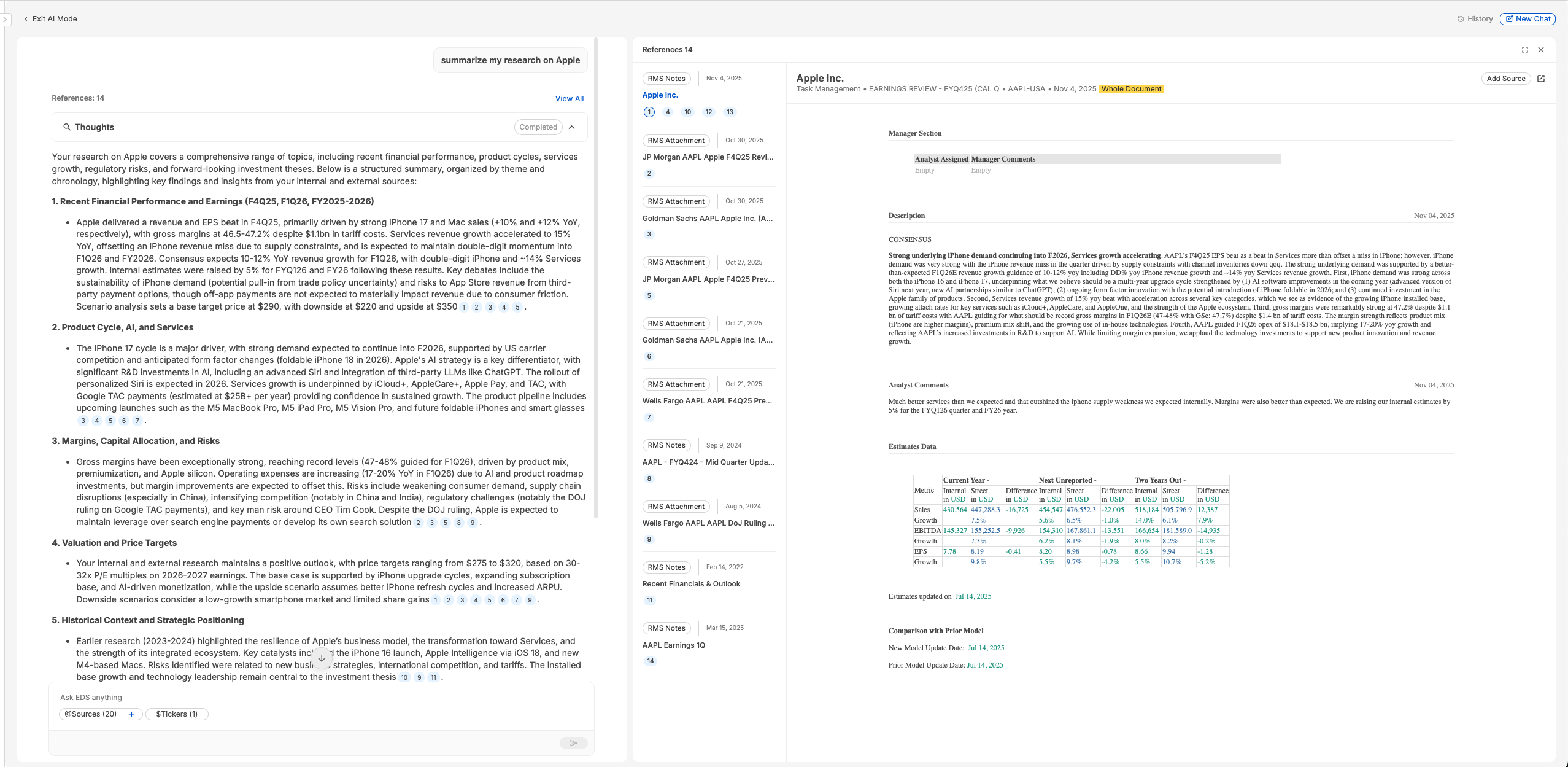
Your thesis, notes, price targets, catalysts, estimate revisions, and coverage gaps — queryable the way an analyst would read them. "What has changed across our semis coverage since Friday?" "Where does our view disagree with sell-side consensus?" "Which coverage is stale?" Answers come back cited, scoped to your universe.

Screening That Lands in Your Process

Describe what you're looking for in your own language — factor profile, thesis pattern, how it fits what you already hold. Fusion AI runs the screen against your data, your coverage, your watchlists. Results are ready to move into research.

Portfolio Monitoring That Catches Drift Before You Do

Continuous, not on-demand. Fusion AI watches for thesis drift, catalyst hits, factor exposure changes, and proximity to risk limits — against the actual thesis and sizing in RMS. You get a short summary when something has changed, with a suggested next action. Nothing moves without approval.

Analytics You Can Show Your Investors

Every risk number, attribution figure, and exposure calculation routes through EDS's verified engines. Fusion AI writes the narrative; the numbers are computed, not generated. The output drops into an Investor memo without rework.

BUILT FOR INSTITUTIONAL USE

Answers Respect Your Access Controls Automatically

Fusion AI inherits the same permissioning as the rest of the EDS platform. Every response is scoped to what that user is authorized to see — across portfolios, strategies, and data sources. There is no separate AI access layer to configure. Permissions are structural, not applied as a policy after the fact.

Full Audit Trail — Every Output Is Traceable to Its Source

Fusion AI outputs include citations back to the analyst notes, data points, and calculations that informed the answer. Every tool call, data retrieval, and computation step is logged. Teams can review what was asked, what data was used, and how the answer was assembled — which matters for compliance, for investment process review, and for building trust in AI outputs over time.

Trust Credentials

SOC 2 Type II

Enterprise security controls with encryption in transit and at rest. Built for institutional data requirements.

Zero-Retention Inference

Client data is not retained for model training. What you ask stays within your environment.

SSO / SAML

Enterprise authentication integrated with access-aware results across every channel and workflow.

HOW IT CHANGES A MONDAY MORNING

Portfolio Reviews

A PM at a fundamental long-short fund used to spend the better part of a morning every week checking whether her positions still matched the research. Open RMS for each thesis. Open the risk system to see factor exposures. Open performance attribution to find what had actually driven last week's P&L. Stitch it together in a spreadsheet. Look for the positions where the story had drifted. By the time she had a clean view, half the morning was gone and the team meeting was starting.

Now she asks Fusion AI one question. The review runs against her live RMS, her factor model, and her attribution. It comes back as a cited memo showing which positions have drifted from their thesis, where sizing no longer matches conviction, and which factor tilts aren't supported by the research.

Last week, the memo flagged a position where the thesis was six months old and estimate revisions had quietly turned negative. She trimmed it on Tuesday. It would have shown up in next week's performance review.

This portfolio review proves everything else on this page: research and risk in one pass, every number computed, every claim cited, every retrieval scoped to what she's entitled to see.

    What's in the Cited Memo
  • Thesis summary and conviction framing for each position
  • Current sizing vs. research support
  • Recent performance and attribution
  • Factor and benchmark-relative risk changes
  • Stale thesis coverage and drift flags
  • Citations and calculation lineage
  • Next-step recommendations — no auto-action

Every number comes from a deterministic engine. Any portfolio-affecting action requires explicit human approval. That boundary is architectural, not a policy layer.
Photo

Fusion AI on RMS

"We're not a competitor to Claude. We're what makes Claude's answers about your portfolio correct."

FLEXIBLE DELIVERY

Wherever Your Team Works, Fusion AI Is There

EDS is the layer that makes institutional analytics usable across workflows and channels. Fusion AI is accessible inside the platform, through REST APIs, and via MCP — so it works wherever your investment team operates, not just inside a single interface.

EDS Platform

Fusion AI Risk, multi-source research workflows, and portfolio intelligence — available inside Nexus alongside the analytics and data your team already uses daily.

REST API

91+ read analytics calculations accessible from client systems and internal tooling. Build automated briefings, risk alerts, and portfolio summaries grounded in your proprietary data.

MCP — Claude, ChatGPT, Perplexity

EDS exposes its analytics via a Model Context Protocol server. Note search, retrieval, and analytics queries are queryable by any connected AI agent or external workflow today.

Office Plugins

Analytics and research surfaces inside Outlook, Word, Excel, and OneNote — the tools analysts already use — without leaving their workflow to open another application.

IC Memo and Portfolio Review

Research-first portfolio intelligence report — from thesis to analytics to cited memo — assembled in one motion and delivered in the format your investment committee expects.

Continuous Monitoring

Streaming event fusion, continuous thesis-versus-position reconciliation, and adaptive personalization built on explicit fund configuration and operating model.

EXAMPLES

Questions Fusion AI Can Answer

Fusion AI understands the full context of your investment process — research, risk, portfolio, and attribution together.

  • "Which positions have sizing that has drifted from analyst conviction?"
  • "Where is the portfolio carrying factor risk that our research doesn't justify?"
  • "What research has been updated in the last three days, and what changed?"
  • "What is driving underperformance vs. benchmark this week, attribution-decomposed?"
  • "Which thesis notes are stale given the last earnings cycle?"

Analysis That Connects — and Answers

Fusion AI transforms analysis by connecting natural-language queries to a complete, unified investment process — helping teams surface insights faster, operate with greater clarity, and improve investment outcomes.

HOW EDS COMPARES TO YOUR CURRENT AI STACK

Where Does Fusion AI Fit If You Already Use Claude, ChatGPT, or Perplexity?

Three scenarios, three honest answers.

Plain ChatGPT, Claude, or Perplexity

Excellent for public text: earnings call summaries, regulatory language, drafting. Ask them about your fund and you get a plausible-sounding answer from training data. It will not be your portfolio, your factor model, or numbers that survive a review.

Where EDS fits: Fusion AI answers the same question with live, computed numbers from your data. The alternatives summarize the world. EDS knows your fund.

Claude, ChatGPT, or Perplexity connected to EDS through MCP

This already works. The EDS Model Context Protocol server is live, and analysts can run earnings previews in Claude today. When that happens, the AI is calling EDS. The semantic layer underneath is what makes the answer usable. Without it — without EDS resolving dates, benchmarks, factor models, and entitlements before computation runs — MCP is just plumbing.

Where EDS fits: If your team works in Claude, connect through MCP and the answers about your fund become correct. Fusion AI is the same semantic layer, packaged as governed workflows for analysts who don't want to hand-build prompt chains.

Enterprise AI seats — ChatGPT Enterprise, Claude for Work, Perplexity Enterprise

Enterprise seats solve the privacy problem: prompts don't train the model, data stays in the tenant, IT gets admin controls. Real, and not something we replace.

What they don't solve is computation. None of them compute factor attribution against your positions, hold your RMS, or produce an audit trail that satisfies institutional compliance.

Where EDS fits: Keep the seats. EDS is what makes them answer correctly about your portfolios — through MCP, with the same controls and deterministic numbers you'd get inside Fusion AI.

See Fusion AI on Your Data

Walk through a live session using your research, portfolio, and risk data — and see how Fusion AI answers the questions your team asks every day.

Frequently Asked Questions

How is Fusion AI different from Claude with connectors to our data?

Connectors move text. They don't carry meaning. Fusion AI resolves which date range, factor model, benchmark, and portfolio scope apply before computation runs, enforces your entitlements structurally, and returns numbers from verified engines. If your team lives in Claude, the MCP route gives you the same semantic layer inside the tool you already use.

What data does Fusion AI use?

Your data. Research notes, models, KPIs, transcripts, trade history, exposures, attribution, and risk — unified in Nexus. No client data is retained for model training.

Can Fusion AI replace analyst research?

No. It removes the manual steps between a question and a grounded answer. Judgment stays with the team.

Can Fusion AI be accessed outside the EDS platform?

Yes — Office plugins, REST API, and MCP. Same controls, same entitlements, same audit trail.

What about firms that already have an internal AI team?

The model and interface are the easy layer. The structured research, portfolio, and risk context underneath takes years. Most internal teams use Fusion AI alongside their own work, and some connect through MCP to keep building on their own stack.

Ready to Strengthen Your Investment Process?

Name