Speed determines how much value investors get from their analytics platform
TL;DR: Hedge fund managers’ time is their most precious resource. Between April and July we rebuilt how EDS pulls up and delivers data, including the engine that answers every question, and cut average load time from 15 seconds to 3, about 80% less waiting. Typical questions are now answered in less than half the time. For investment teams, the practical result is that attribution, risk, and screening questions are answered on the fly during a meeting. This matters even more for AI agents, which ask the system dozens of questions in a row, so every delay adds up.
Investors value their time above all else, and yet most software built for the buy-side has been forcing them to wait on long load times. Even with modern technology, attribution for a large portfolio across several asset classes can take a very long time, and some risk reports are so slow they have to run overnight. Teams accepted the wait as the price of doing serious analysis on a lot of data. We knew investors wanted a better experience.
One of the things I care about most in an investment platform is whether it keeps up with the user’s train of thought. Investment analysis is iterative. You may start with one question, consider the answer, and almost immediately have another. A platform has to give the right answer, but it also has to answer fast enough that the analysis feels like a natural back-and-forth conversation.
That is why we treat speed at EDS as a core part of the product. We plan and prioritize it like any other feature, and we test every release to make sure nothing gets slower.
What changed, in numbers
In April, the average platform load across our client base took about 15 seconds and now takes about 3 seconds. That is close to five times faster, using the same data and the same workflows.
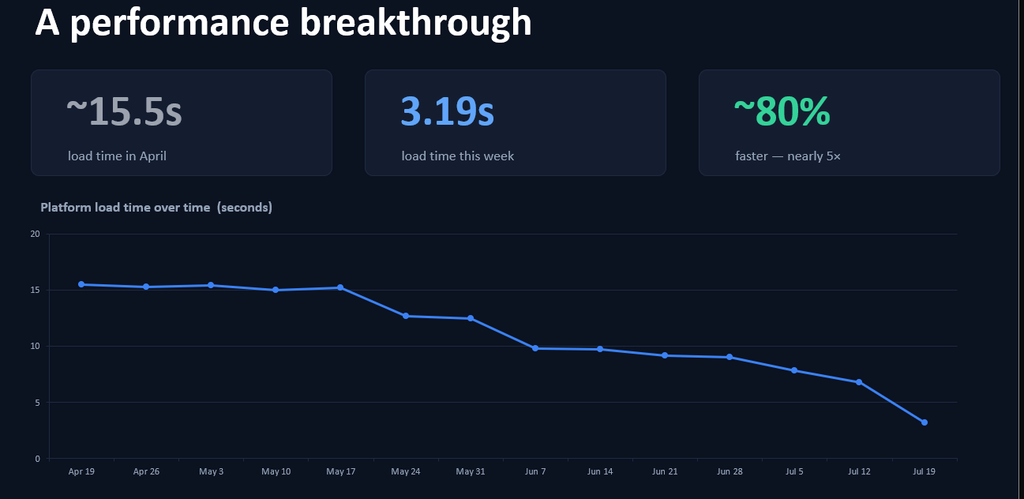
A series of improvements added up through May, June, and July, and the biggest improvement came from rebuilding the query engine, the part of EDS that answers each request.
The number that matters most is how long a single query takes to come back to the user. In other words, how long does the platform take to answer your question. We measured every query before and after the rebuild, not just the average, because averages can hide the slow outliers, and those are what frustrate people most.
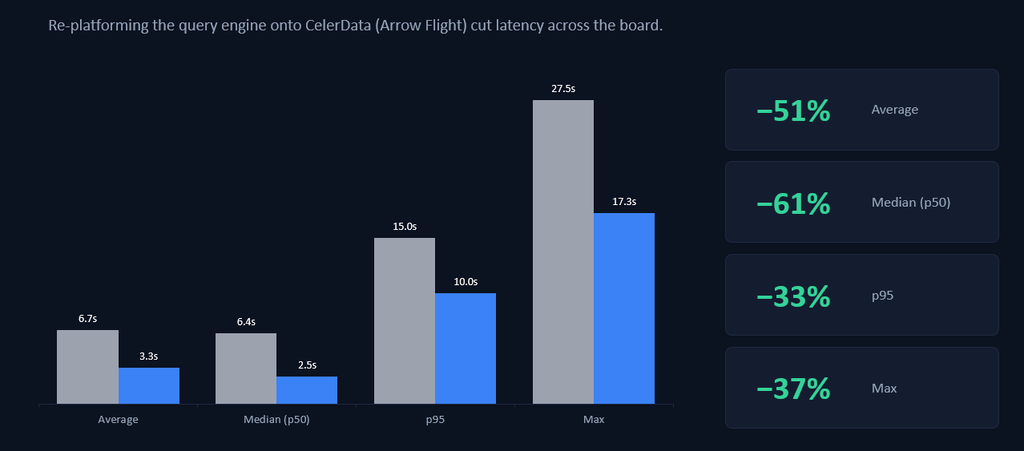
The average query now comes back in 3.3 seconds instead of 6.7, cutting the wait roughly in half (down 51%). The slowest queries got faster too: the slowest 5% are about a third quicker, and the single worst case is 37% quicker. Those slow ones are the numbers we watched most closely, because when a system is usually fast but sometimes makes you wait, people remember the wait.
These numbers are averages across all our clients, measured on real day-to-day use, and firms with the largest portfolios may see different numbers.
How speed changes the investment management workflow
Saving twelve seconds several hundred times a day adds up over a quarter. More importantly, a fast system is used more often. When changing a benchmark, date range, grouping, or assumption takes only a moment, teams ask more follow-up questions, rule out bad ideas early, and spend their time on the questions most likely to change an investment decision.
Speed is part of the product. Faster load times mean more than getting answers quicker. You get more out of the system, you ask better follow-up questions, and the AI agents built on your data do better work” - Stan Miroshnikov, CTO
AI Agents raise the bar again for portfolio analytics
There is a second reason we prioritized this work now. AI agents, which connect to EDS through the EDS MCP layer, put far more strain on the platform than people do. A person asks one question and waits for the answer, while an AI agent working on a research task may send dozens of requests to answer a single question, and each one needs to come back quickly. Every retry and re-check costs tokens and makes the agent less reliable as the task can time-out.
AI agents work best when every request comes back in seconds. The rebuild that made EDS faster for people also makes it practical to run AI agents safely on fund data. An agent can only see what the person it works for is allowed to see, and every request it makes is logged for audit.
The bar keeps moving higher
I do not expect us to ever call our work on platform speed finished. Data keeps growing, workflows keep changing, more people use the system at the same time, and AI agents use it in ways that did not exist two years ago. Our job is to stay ahead of those demands without asking clients to change how they work.
See it on your own data
Speed claims in this industry usually come from a vendor's demo, with clean data and a single user. The better test is your own portfolio, your own history, and your whole team logged in at once.
Existing clients already have these improvements, with nothing to install and no change to how they work (besides getting answers much faster). If you are evaluating a portfolio analytics platform and speed has been the reason your team avoids the system you have, bring your data and time it yourself.
Request a demo →