An AI earnings preview powered by Equity Data Science
TLDR: Generic AI agents can summarize analyst expectations before a company reports, but institutional investors need more than that. Fusion AI goes further by comparing street expectations against the fund’s own intelligence: the model, the price target, the thesis, position size, conviction level, and risk profile. To demonstrate an AI-powered flow, we ran the EDS Earnings Preview agent on Apple through the EDS MCP layer inside Claude. Here is what that looks like.
Earnings Preview is one of several workflows in Fusion AI. Stocks Brief gives you a one-click read on a company. Thesis Conflict Scan checks new filings against your investment thesis. Risk/Return Analysis prepares a client-ready memo. You can also schedule earnings previews for every holding and have them delivered ahead of each report.
Each workflow gives you a starting point. From there, you can ask follow-up questions, check another position, or build a dashboard around what you want to investigate. In the Apple session below, a question about management's comments led us to look at our Broadcom position.
What is an AI earnings preview workflow?
An AI earnings preview workflow is a repeatable process any PM or analyst can run in which an AI agent gathers the needed inputs for a pre-earnings review including guidance, consensus, management commentary, positioning, and the fund's own estimates, targets, and notes. It then assembles all of that information into a sourced document to be reviewed prior to the earnings report. Institutional investors need a specialized AI agent rather than a generic AI tool built for public-market research, because the agent must know the fund's own estimates, investment thesis, positions, and risk model, and trace each answer back to its source.
You can use Fusion AI inside EDS or through an AI tool such as Claude, connected through EDS MCP. Some teams prefer to stay within EDS's built-in workflows and controls. Others want to explore questions in the AI interface they already use. EDS MCP gives those tools secure access to the research, portfolio, risk, and attribution data in the EDS system of record. That gives the agent the context behind your firm's investment philosophy, process, and discipline.
We know the importance of process and how unique the investment philosophies can be from one fund to another. EDS has supported fundamental investors since 2012 and was built by a team of buy-side execs with experience spanning Citadel, Millennium, and Morgan Stanley.
Below, we show how an earnings preview works through Claude, including the follow-up questions a PM or analyst might ask.
Here is the full video demo:
The setup: Using Claude with the EDS MCP
We recorded Fusion AI running inside Claude through the EDS MCP, pointed at the EDS demo fund with 52 positions (the data is not real but representative). Every tool call and response was captured from the production MCP server, and every number below is quoted from one of those responses. At the time of the session, data was as of August 7, several weeks ahead of Apple's September-quarter report.
The session started from the Fusion AI agent library, meant to help analysts jump into an analysis without needing to think of the right prompt. Each agent is a fixed workflow with declared inputs and a declared source list, approved and published by the firm.
The Earnings Preview agent takes one ticker and draws on earnings filings, investor presentations, news, internal notes, and quant data, including the fund's own estimates. For a head of research, that turns a prompt into a full repeatable workflow: defined once, with the same sources and the same checks for every analyst.
How the preview works
The preview ran through four requests, each building on the last with the only input being the company ticker and one click from the library. Importantly, the user did not need to choose the transcript, source list, price-target table, or model fields. Choosing those inputs by hand would slow the workflow down.
Three calls later, the agent had retrieved the position, the street setup, and the fund's view on the name.
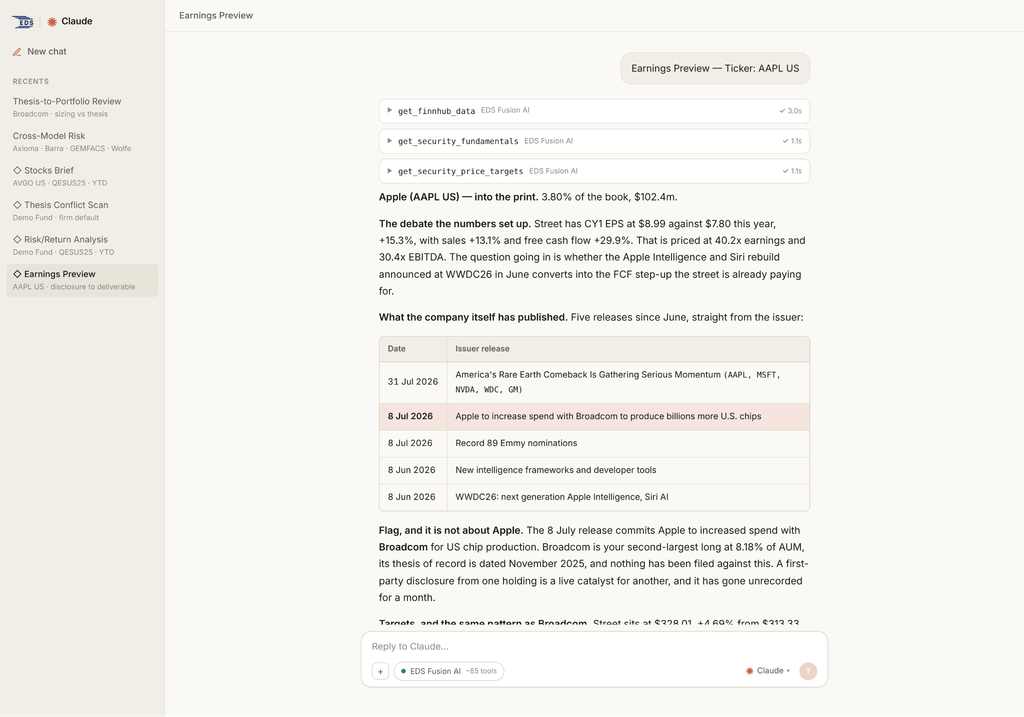
From there, we had two follow-up questions and a directive to build a custom dashboard:
- What did management say?
- What does that mean for our Broadcom position?
- Build the full preview dashboard.
The first came back as sourced quotes from the call, each marked with its tool call and transcript ID so a PM can open the original. The second crossed positions: Apple's disclosure of a multiyear Broadcom agreement landed on a Broadcom thesis that had not been revised in nine months, and the agent put one question to the desk, whether the commitment changes the base case and the sizing, without calling the position mispriced. The third moved from public synthesis into the system of record, pulling the fund's model fields, factor exposures, holdings risk, and research notes into a thirteen-section dashboard.
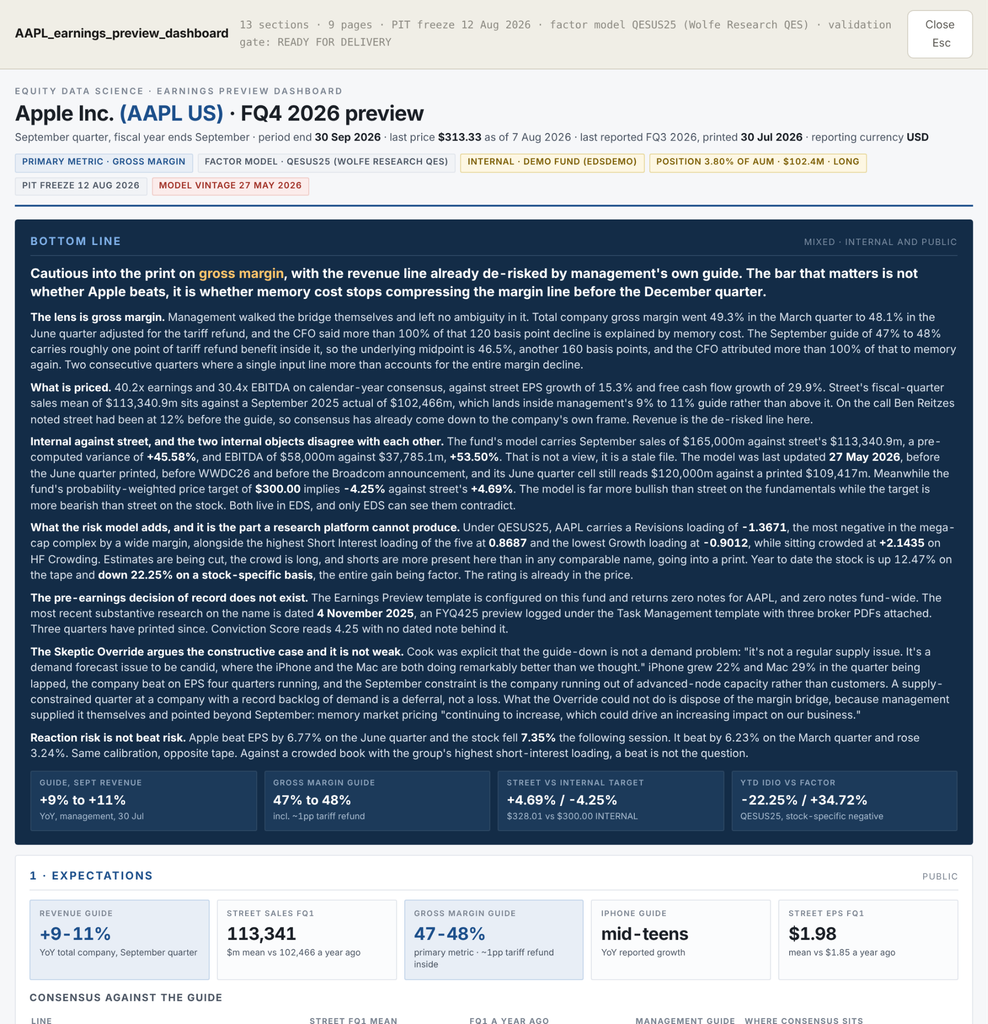
Some of what the answers and the dashboard drew on was public. Other findings depended on data only the fund's own system had: in the Apple session, an internal model that had not been updated since before the last quarter printed, a stock-specific return that was negative for the year, and a position heading into earnings with no dated note behind it.
Cross-referencing private data with public sources is what separates an institutional-quality AI workflow from a generic chatbot built for retail finance.
How investors know they can trust the output
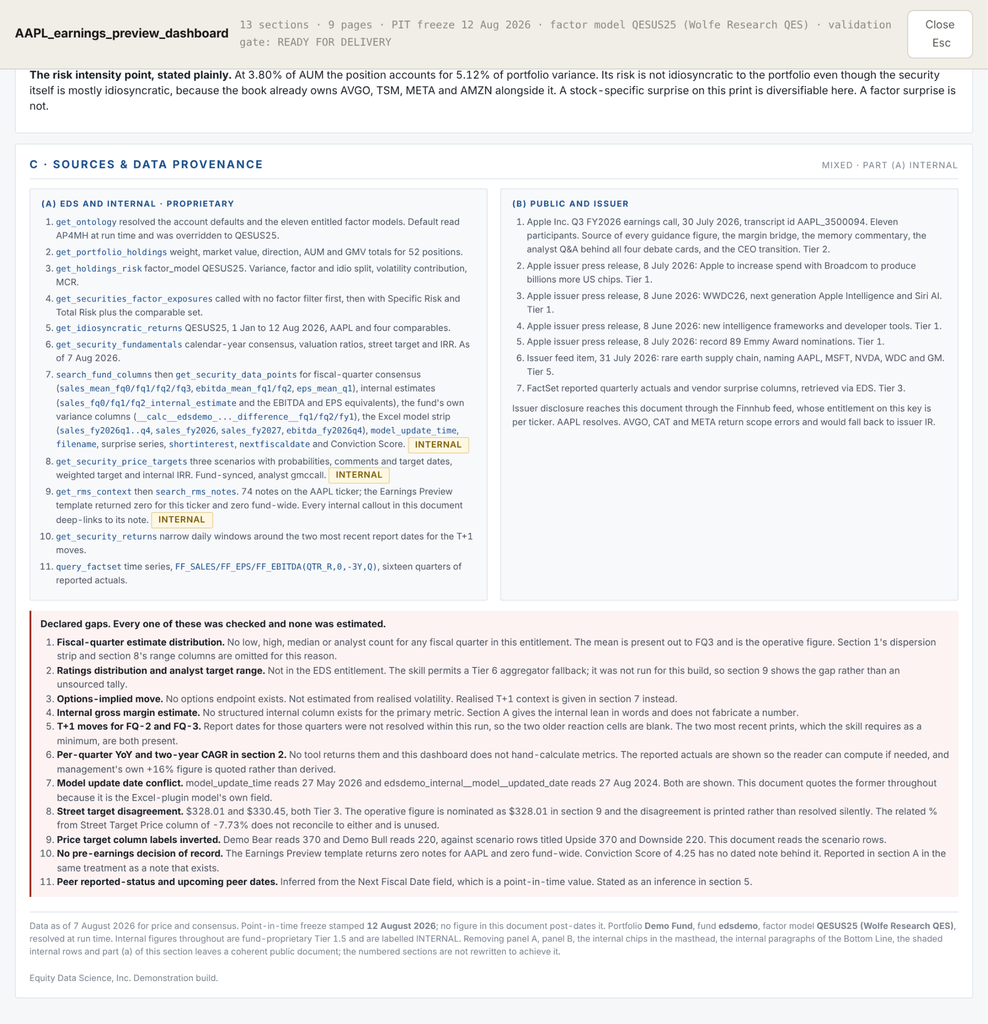
A preview is only useful if the investor can audit it without rebuilding the whole deliverable. The dashboard declared every gap it could not fill, with a reason and a confirmation that nothing was estimated. Every proprietary figure carried an “internal” label and linked to the underlying note in the EDS research management system. It also passed a validation gate on point-in-time consistency and source tiers before it was marked ready.
Try it on a position in your book
The most actionable findings in the Apple session were around the fund's own research, and an agent can only do that kind of work when it interacts with the system where your internal research is stored. We made the same argument in What Is Your Portfolio Intelligence Missing?: if information can change an investment decision, it belongs in the system where that decision is made. EDS MCP extends that system to Claude, ChatGPT and the other AI tools teams already use. For a broader checklist, see How to Choose an Investment Analytics Platform.
The Apple session ran on a demo fund with representative data for illustration purposes. Let’s test this together on a core position in your book.