Risk Management
Real-Time Insight Into Factor, Idiosyncratic, and Thematic Risk
Risk Management gives investment teams a complete, real-time view of how portfolios behave, where exposures are concentrated, and how risk evolves as markets move and research updates. Instead of working from static reports, fragmented models, or after-the-fact analytics, teams engage with risk as a living part of the investment process.
Designed for fundamental investors, Risk Management integrates exposures, factor sensitivities, idiosyncratic contributions, drift monitoring, and scenario analytics into a single connected workflow. Risk becomes easier to interpret, easier to act on, and easier to evaluate in the context of research and portfolio decisions.
By combining risk with research and attribution through Nexus, teams gain a clearer understanding of how decisions affect portfolio resilience—and how to proactively manage uncertainty.
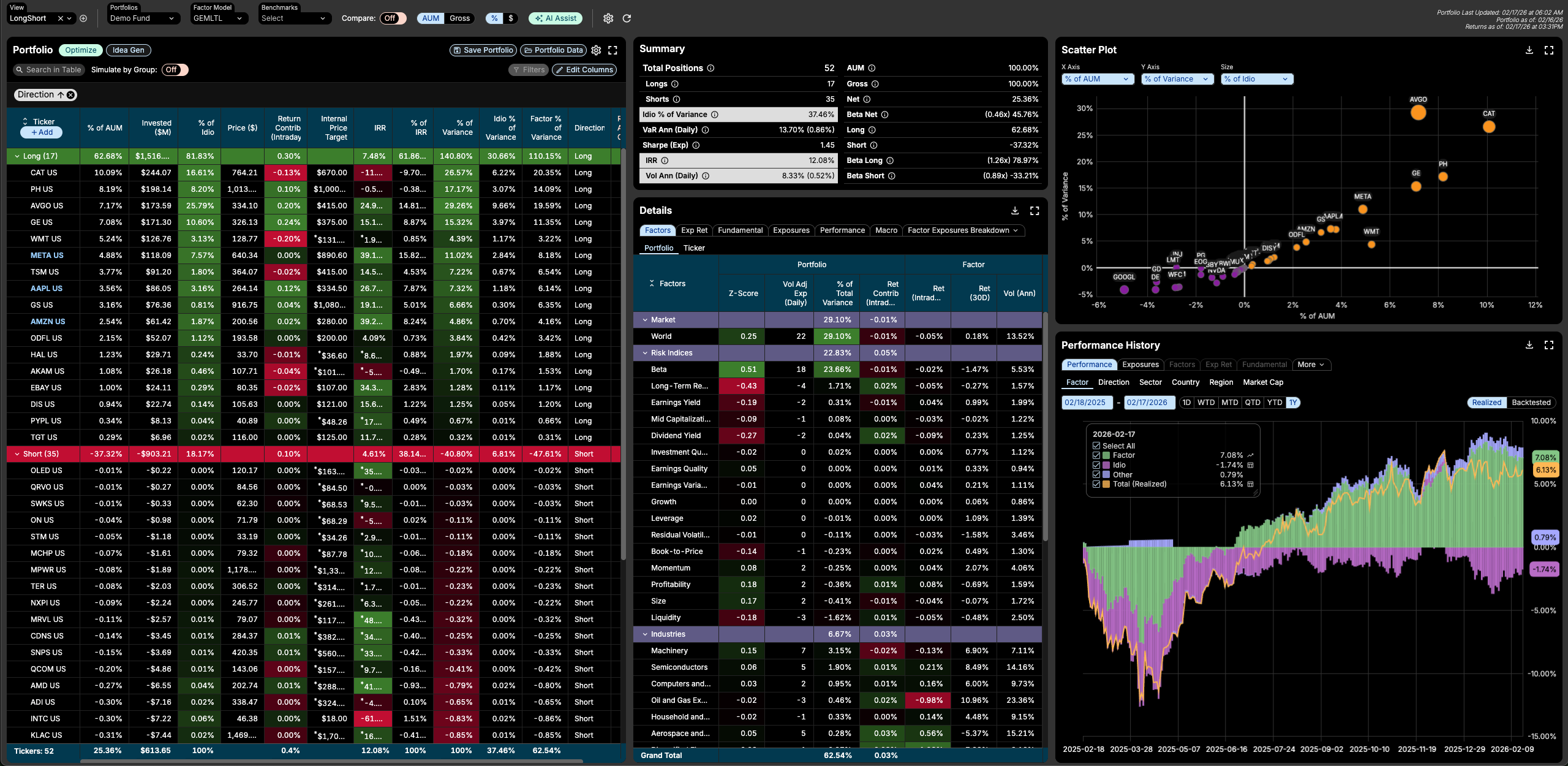
A Connected View of Portfolio Risk
Key Capabilities
-
Real-time factor, style, thematic, and macro exposures
-
Idiosyncratic risk decomposition by name, sector, strategy, and factor model
-
Top-down risk and exposure analysis
-
Deep risk analysis (volatility, factor risk and VAR)
-
Drift detection for weight, factor, and style changes
-
Sensitivity analysis to evaluate portfolio response to factor shocks
-
Scenario and stress testing for macro, sector, or custom events
-
Integration with risk models including MSCI, Axioma, Wolfe, and internal frameworks
-
Create hedging baskets or leverage existing baskets to hedge factor risk for individual securities or for the entire portfolio
-
Make dynamic changes that reflect both risk and research views
-
Portfolio- and security-level dashboards
-
Direct linkage to Research Suite and Attribution workflows
Why Risk Management Matters
Use Cases
- Portfolio managers evaluating exposures before a rebalance or catalyst-heavy period
- Risk teams monitoring sensitivities ahead of macro event
- Analysts reviewing how their coverage names behave at the factor level
- Committees reviewing risk posture for client or regulatory requirements
- Teams dissecting risk changes after significant position adjustments
See How Risk Management Strengthens Your Investment Workflow
Frequently Asked Questions
Factor exposures, beta sensitivity, idiosyncratic risk, drift and thematic exposures.
Yes. Exposures and sensitivities update continuously as the portfolio moves.